
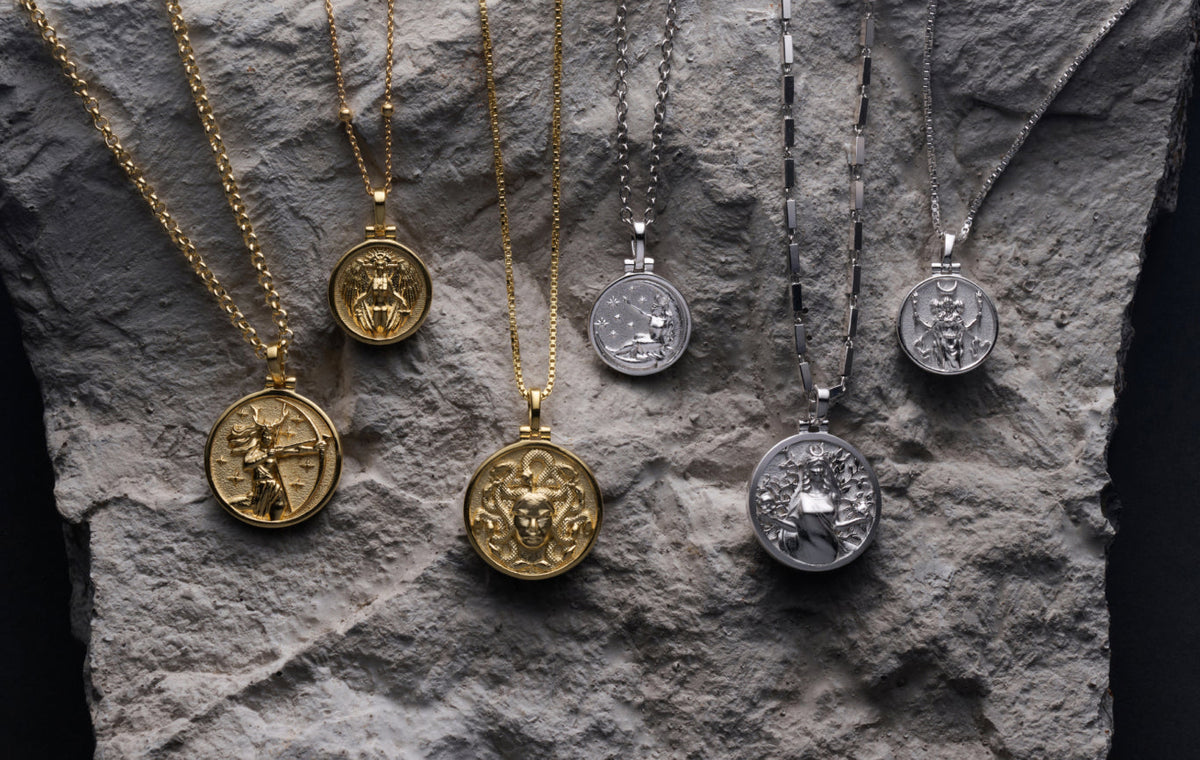
While there’s a time and a place for the shorthand that ascribes each Greek Goddess a single domain — Athena is "wisdom"; Aphrodite is "love"; Persephone is "spring" — it’s an act of convenience that’s directly in conflict with the expansive nature of each deity. (Consider it the mythological equivalent of describing a person by their job title.) In the myths that landed these Goddesses their place in the immortal cannon, every single one is more complex, more nuanced, and more multifaceted than their one-word monikers. While interpreting their ancient authors is the work of a lifetime (and multiple doctorates), this guide is designed as a starting point: a field guide to these legendary deities, as well as their symbols and motifs, to shine a light on the seeming contradictions of these mythic figures.
In a world obsessed with ascribing a single, simple motivating force to all female figures, these Goddesses exemplify range. Athena is a war Goddess whose interest in war itself seems somewhat theoretical; Persephone is a downy innocent with the fortitude to take on not only the king of Hell but also her own mother; Hecate is a three-faced Goddess whose ancient power has evolved to exist inside the questions rather than try to answer them; and Aphrodite is a masterful manipulator whose greatest trick is convincing the world she’s a simplistic sex object. Every single one deserves a deeper look.
Who is Athena, and what does she actually represent?
Athena’s shorthand is “wisdom, warfare, and handicraft” (more on that last one in a minute). But even the combined weight of these three descriptors doesn’t give her the nuanced read she deserves.
In the most common version of her myth, Athena is born from the forehead of Zeus, arriving fully grown and fully armored. From that first moment, she’s the living embodiment arriving prepared: clad in protection from even the instant of her birth, able to be surprised by nothing. The origin story makes sense when you realize that the ancient Greeks drew a clean line between her type of warfare, a strategic, intellectual warfare, and the bloodlust of violence in general. The distinction mattered so much that the single act of war was split into two deities: where Ares represented war as chaos and insatiable appetite, Athena represented war as cool-headed calculation. She stands as somewhat unique among the global pantheon of war Goddesses: an agent of war who isn’t vengeful, fearsome or fiery. Perhaps owing to the peculiarity of her birth, her form of battle takes place almost wholly in the mind.
This is the version of Athena that serves as Odysseus’ guardian and mentor throughout his ten-year journey home. The similarity of their worldviews can’t be untangled from her influence—is Odysseus a similarly level-headed warrior because of Athena’s shaping, or does Athena choose him because she sees herself in him?—but he benefits greatly from her closeness during his epic struggles. She reshapes his appearance when disguise proves more promising than confrontation. She counsels patience when his itch to act threatens his fate.
Her constant calls for moderation, restraint, temperance, recall the poised and patient actions of the owl, which is her sacred symbol. In fact, reservation and slowness seems to be one of her calling cards—a feature, not a bug. In one version of the founding myth of the city of Athens (her namesake), Athena competed with Poseidon in a contest to see who would become the city’s patron. Poseidon, ever the showman, dramatically split the earth into a saltwater spring, connecting the city to trade and (undrinkable) water. Athena, for her part, offered a domesticated olive tree: a slow-growing gift that rewards patience with wood, olive oil, and food. The Athenians chose the long game, and ultimately, the exports that would shape their culture and symbolize abundance for centuries to come. It’s no surprise, then, that olive wood and olive trees remain among her most recognizable symbols.

Who is Persephone: immortal queen or kidnapped victim?
For all of the variations of Persephone’s myth that exist from antiquity, one element remains more or less the same: Persephone is picking flowers when she is abducted by Hades, who ferries her away to the Underworld to be his queen. In nearly every version, her agency is stripped: she is the very picture of a naive and virginal youth, down to the pseudonym Cora or Kore she is given, which translates to “the maiden.” Hades is written as the villain, but even the girl’s champion—her mother Demeter, whose grief over her lost daughter holds the earth hostage and makes it a barren wasteland—leaves little room for Persephone’s own desires.
Trapped between two contesting wills—the will of her mother and the will of her husband—Persephone’s will is notably absent. Both forces desire her company, in the simplest terms. Ultimately, Persephone eats the fruit of the Underworld: a few pomegranate seeds, whether through trick, hunger, or just a desire to be the least bit in control of her own destiny. Because she has tasted them, she cannot be returned to the earth fully. So a deal is brokered: half the year in the land of the living with her mother; half the year underground as Queen of the Underworld. But was it a choice?
Different stories disagree about why Persephone ate the pomegranate seeds. But it’s notable that the entire story is told via competing forces vying for Persephone’s time, without leaving room for her own autonomy. Perhaps she read the writing on the wall, realizing that dividing her life in two was the only way for her to have any agency at all. That there is a sort of freedom to not belonging fully to anyone—the living or the dead.

Who is Hecate, and why does she stand at the crossroads?
Of all the Goddesses, Hecate is perhaps the most difficult to flatten. The oldest surviving images of Hecate depict her with three faces: each turned toward a different direction, together surveilling all that exists. It’s an uncanny image: impossibly wise, almost all-knowing, a representation of fragmentation and unity at once. How can something diverge so dramatically and still be whole? This is the question Hecate poses, again and again. She thrives in the murkiest territories of life, where no answer is simple.
It’s no surprise, then, that she is the Goddess of crossroads, night, magic, and transitions. All domains without clear boundaries. She thrives in darkness, carrying a torch that sheds just enough light to see but not quite enough to follow. A beacon would mean something different. This is a road that must be walked with trust, not checked by sight. She transits between worlds, her footsteps echoing with the clink of keys, because she alone can unlock passage between worlds that other gods keep firmly separate: the living and the dead, the visible and the hidden, the moment before a choice and the moment after.
In some histories, Hecate predates the Olympian pantheon and was honored as protector of the household in ancient Athens. The strangeness of her name suggests that it may have pre-Greek origins, giving her a power more ancient and mysterious than the other Goddesses. No matter where her earliest origins lie, there is something strangely primordial about her that is preserved: something that lives cloaked in darkness, eyes cast ever outward as if in watch for some predator. Perhaps that explains her continued appeal: as a symbol of feminine strength in all stages of life, and a practitioner of some magic that even the old gods cannot understand, she exists apart from time and also deeply entrenched in it. In shades and shadows, she is the ultimate divine feminine archetype: multi-phased; shapeshifting, yet enduring.

What does Aphrodite represent, beyond beauty?
For almost as long as she has existed, Aphrodite’s power has been twisted into a receptacle for the male gaze. The Goddess of love, beauty, sex, and fertility has long seemed a likely vessel for male projections of desire—nevermind that her original myths are less about her as a sex object than as a canny negotiator.
Throughout Aphrodite’s myths, she trades favors, brokers outcomes between rival gods, and consistently gets exactly what she wants from Olympians whose technical prowess far exceeds her own. When Paris awards her the golden apple in the judgment that leads to the Trojan War, he does so because of her strategic offering: the hand of the most beautiful woman on earth. While the other Goddesses offer power and glory, Aphrodite can see what motivates this mortal prince more than territory or wisdom, and she seizes on it.
She continues to exercise her agency throughout The Illiad, appearing to both Paris and Helen to guide their actions, and even engaging in battle herself before being wounded. Though the more warfaring gods remind her that she isn’t suited for conflict, she proves them wrong again and again by using a different sort of strategy: her powers of persuasion and seduction.

How do you choose your Greek Goddess necklace?
Each Goddess has an energy all her own, and it radiates through her myths. Athena’s energy is thoughtful, patient, but exquisitely timed: she strikes when the moment is right, with the strategy that will most benefit those she cares for and leave as little collateral damage as possible. Call on her in any situation where half-baked action can do more damage than no action at all. As a representation of the highest form of feminine intelligence, she understands the delicacy and politics of any situation, and can puzzle out a solution from even the murkiest waters.
By contrast, Hecate’s energy is designed for living in the mist, not untangling oneself from it. When no clear answer exists…when each path of the crossroads leads to something unknowable…when the fog is impossibly dense, she is the one whose council you need. Call on her when the darkness is total and the only light is your own intuition. She will provide the key—or if not, at least keep you company through the most indecipherable seasons of your life.
Persephone’s energy is the energy of blooming where you’re planted. Presiding over both the realms of light and dark, she is truly able to transcend any situation simply by refusing to fit into a single mold. Call on her in times when your divine duality needs to be recognized, or when the will of others threatens to confine you to only one life.
Aphrodite’s energy is perhaps the most misunderstood of all. Beauty and love are a part of it, but they are not as passive as the classical artists would have had you believe. Instead, Aphrodite’s beauty and powers of attraction are tools—traits to be used strategically, just as Athena would use her shield. Call on her in moments when you are underestimated or doubted for your soft nature, or when persuasion and flattery will gain more ground than conflict.
Each Goddess is deserving of materials as lasting as their stories. Sterling silver and gold vermeil speak to the enduring power of these myths, and channel the most ancient forms of adornment. Followers of Hecate may prefer silver, because of its association with lunar energy, while those aligned with Aphrodite may choose gold because of its timeless desirability. By the same token, some gemstones are particularly suited to each Goddess’s energy: red garnet to symbolize Persephone’s pomegranate seeds; gleaming white sapphire to magnify Aphrodite’s beauty; color-shifting black mother of pearl to reflect Hecate’s light amid darkness.
Frequently Asked Questions
Is Athena only a war Goddess? |
| Not in the way "war Goddess" usually implies. Athena represents strategic warfare specifically, favoring planning and patience over force and chaos, which the Greeks associated instead with Ares. Her founding myth in Athens, won by offering the olive tree over Poseidon's saltwater spring, reflects this: she is the Goddess of the long game, not the immediate strike. |
Did Persephone choose to stay in the underworld? |
| By most accounts, she ate the pomegranate seeds herself, an act that traditionally binds a person to the underworld permanently. The result was a negotiated arrangement: Persephone rules as Queen of the Underworld for part of the year and returns above ground for the rest, honoring her divine duality and letting her pass time in both realms. |
Why does Hecate have three faces? |
| The oldest surviving depictions render Hecate with three faces looking in three directions at once, symbolizing her role at crossroads and thresholds, the places where no single path or answer is correct. This triple form also reflects her authority over life’s transitions: she is concurrently the maiden, mother, and crone, existing outside of the boundaries of traditional time. |
Was Aphrodite only the Goddess of beauty? |
| Aphrodite is the Goddess of many things, among them beauty, love, lust, desire, fertility, passion, prosperity, and victory. Though some of these traits may be the result of her conflation with her Roman counterpart Venus, she holds more power than the simple “Goddess of beauty” moniker gives her credit for. In her myths, she is depicted as a savvy and strategic force, apt at getting what she desires rather than just being a vessel for the desires of others. |